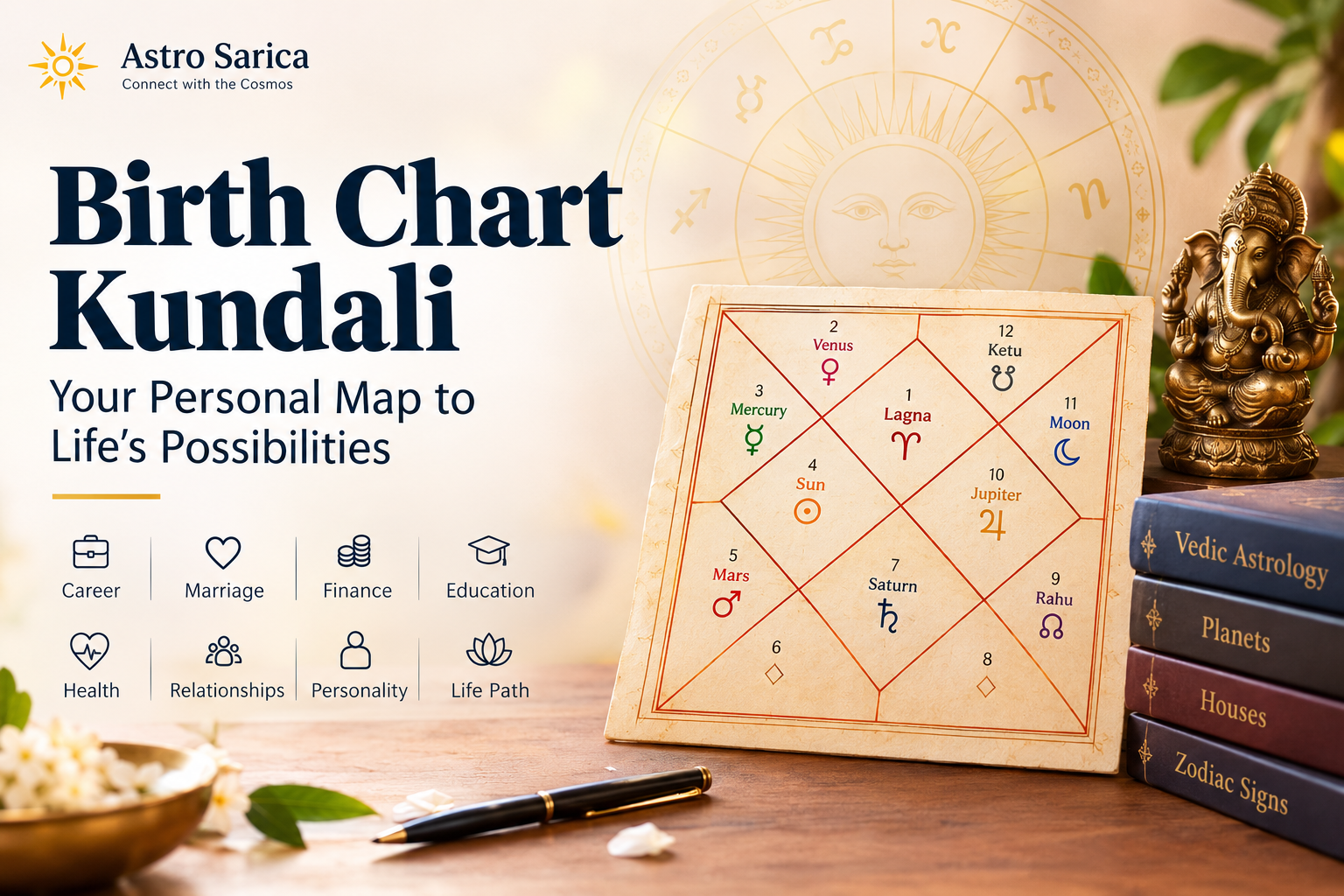
A birth chart kundali is a personal map of the sky created for the exact moment and place of your birth. In Vedic astrology, it is prepared using your date of birth, birth time, and birthplace. The chart shows the positions of planets in different zodiac signs and houses and is traditionally used to understand different areas of life.
People often look at their kundali when they have questions about career, marriage, relationships, finances, education, family, personality, or major changes in life. Unlike a general horoscope based on your zodiac sign, a birth chart is calculated from your individual birth details, so every person’s chart is different.
A kundali is not simply a collection of planetary positions. Its interpretation comes from understanding how the planets, houses, zodiac signs, house lords, aspects, and timing systems work together. This is why two people born under the same zodiac sign can still have very different birth charts and life patterns.
What Is a Birth Chart Kundali?
A birth chart kundali, also known as a Janam Kundali, Janma Kundali, or Vedic birth chart, is a graphical representation of the sky at the time and location of a person’s birth.
The chart is divided into twelve houses, with each house representing a particular area of human life. The zodiac signs and planets placed in those houses provide additional information for astrological interpretation.
For example, the first house is traditionally connected with the self and personality, while the seventh house is associated with marriage and partnerships. The tenth house is commonly examined for career and professional life, while the second and eleventh houses can be considered in financial analysis.
To create a birth chart kundali, three basic details are required:
- Date of birth
- Exact time of birth
- Place of birth
The accuracy of these details matters. In particular, the birth time can affect the calculation of the ascendant and house positions.
Why Is a Birth Chart Kundali Important?
One of the biggest differences between a kundali and a general horoscope is personalization.
A daily horoscope usually gives broad information based on a zodiac sign. A birth chart, on the other hand, is created from the exact circumstances of your birth. This allows an astrologer to examine a much wider range of factors.
A birth chart kundali may be studied for questions related to:
- Personality and natural tendencies
- Career and professional growth
- Marriage and relationships
- Education and learning
- Wealth and financial patterns
- Family and home life
- Personal strengths and challenges
- Major transitions
- Spiritual interests
The chart should be viewed as a complete system. One planet or one house rarely tells the entire story.
Astrology is traditionally used as a tool for guidance and self-reflection. It should not be treated as a guaranteed prediction of future events.
How Is a Birth Chart Kundali Created?
Creating a kundali begins with accurate birth information.
The date of birth establishes the planetary positions for that day. The time and place of birth are then used to calculate the ascendant and the houses.
A simplified process looks like this:
- Enter the date of birth.
- Enter the exact birth time.
- Select the birthplace.
- Calculate the Ascendant or Lagna.
- Determine the zodiac signs associated with the houses.
- Place the planets in their respective signs and houses.
- Examine planetary aspects and relationships.
- Consider relevant divisional charts and planetary periods.
Once these calculations are completed, the resulting chart can be interpreted using the principles of Vedic astrology.
The calculation itself can be done quickly using an online kundali calculator, but understanding what the different combinations mean requires considerably more knowledge.
Understanding the 12 Houses in a Birth Chart Kundali
The twelve houses are one of the most important parts of a Vedic birth chart. Each house represents a different area of life.
1st House – Self and Personality
The first house is known as the Lagna or Ascendant. It represents the self and is traditionally associated with personality, appearance, self-expression, confidence, and general approach to life.
Because the ascendant forms the starting point of the house structure, it has a major role in interpreting the rest of the chart.
2nd House – Wealth, Family and Speech
The second house is associated with family values, speech, savings, accumulated resources, and personal wealth.
When financial matters are examined, astrologers may look at the second house along with its lord, planets placed there, aspects, and other financial indicators in the chart.
3rd House – Courage, Communication and Skills
The third house is traditionally connected with courage, communication, siblings, initiative, practical skills, and personal effort.
It can provide an astrological perspective on how a person communicates, takes initiative, develops abilities, and approaches challenges.
4th House – Home, Property and Comfort
The fourth house relates to home, family environment, emotional foundations, comfort, property, and domestic life.
Someone asking questions about home, property, or emotional security may have this part of the birth chart examined in greater detail.
5th House – Education, Creativity and Romance
The fifth house has several important associations, including creativity, intelligence, education, children, romance, hobbies, and self-expression.
It is commonly considered in questions involving learning, creative abilities, romantic relationships, and children.
6th House – Work, Competition and Challenges
The sixth house is traditionally associated with service, daily work, competition, obstacles, debts, and health-related themes.
It can also be considered when looking at how a person handles responsibilities, competition, and difficult circumstances.
7th House – Marriage and Partnerships
The seventh house is one of the most discussed houses in a birth chart kundali.
It represents marriage, spouse-related themes, partnerships, and one-to-one relationships. For marriage analysis, an astrologer may also examine the seventh lord, Venus, planetary aspects, the Navamsa chart, and planetary periods.
8th House – Transformation and Hidden Matters
The eighth house is associated with transformation, sudden changes, shared resources, research, mysteries, and deeper psychological themes.
Its interpretation can be more complex because it deals with areas of life connected with change, uncertainty, and transformation.
9th House – Luck, Beliefs and Higher Learning
The ninth house is traditionally linked with fortune, higher education, philosophy, spirituality, teachers, beliefs, long-distance travel, and religious or philosophical interests.
It can be particularly relevant when someone wants to explore questions about higher learning, personal beliefs, or spiritual development.
10th House – Career and Public Life
The tenth house is one of the key houses for career analysis.
It is associated with profession, responsibilities, achievement, reputation, public standing, and social status.
However, career interpretation should not be based on the tenth house alone. The ascendant, tenth lord, planets, aspects, and other relevant combinations may also be considered.
11th House – Gains, Networks and Aspirations
The eleventh house relates to gains, income from one’s efforts, friendships, networks, ambitions, and fulfillment of desires.
It may be examined when discussing financial gains, professional networks, social connections, and long-term aspirations.
12th House – Expenses, Foreign Connections and Spirituality
The twelfth house is traditionally associated with expenses, foreign connections, isolation, sleep, retreat, spirituality, and letting go.
Depending on the rest of the chart, this house can have different interpretations and should not be judged independently.
What Can a Birth Chart Kundali Tell You?
A birth chart kundali can be examined for many areas of life. However, the interpretation depends on the complete chart rather than a single planetary position.
Birth Chart Kundali for Career
Career questions are often connected with the tenth house, its lord, the ascendant, and relevant planetary placements.
An astrologer may study these factors to explore professional interests, responsibilities, opportunities, and possible career patterns.
For example, someone considering a career change may use an astrology reading to explore traditional astrological indications while also considering practical matters such as education, experience, skills, income, and personal interests.
A kundali can offer an additional perspective, but it should not replace real-world career planning.
Birth Chart Kundali for Marriage
Marriage is another major reason people seek a kundali reading.
In Vedic astrology, the seventh house and seventh lord are important factors in marriage analysis. Venus and other relevant planetary combinations may also be examined.
A detailed reading may include the Navamsa chart and planetary periods to understand relationship themes and possible periods of significance.
A birth chart kundali should not be presented as a guaranteed method for predicting an exact marriage date. Astrological interpretation is traditionally about tendencies, possibilities, and timing rather than certainty.
Birth Chart Kundali for Finance
Financial analysis may involve the second house, eleventh house, their lords, Jupiter, Venus, and other relevant planetary factors.
The second house is traditionally connected with accumulated wealth and savings, while the eleventh house is associated with gains and income.
Looking at the complete chart gives more context than focusing on a single planet.
Birth Chart Kundali for Education
Education-related questions may involve the fourth and fifth houses, Mercury, Jupiter, and other relevant chart factors.
The fifth house is traditionally connected with intelligence, learning, creativity, and education, while the fourth house has associations with foundational education and learning environment.
The overall planetary picture can help create a broader astrological interpretation.
Birth Chart Kundali vs Western Birth Chart
A common question is whether a Vedic birth chart is the same as a Western natal chart.
The concepts are closely related, but Vedic and Western astrology generally use different zodiac systems.
Vedic astrology commonly uses the sidereal zodiac, while Western astrology generally uses the tropical zodiac.
Because the two systems calculate planetary positions differently, the zodiac signs shown for certain planets may not be the same in both charts.
If you are looking for a Vedic birth chart kundali, make sure the calculator or astrologer is specifically using the Vedic astrology system.
What Information Do You Need for a Birth Chart Kundali?
You generally need three important details to generate your chart.
Date of Birth
Your complete date of birth establishes the date-specific planetary calculations.
Time of Birth
Birth time can be especially important for determining the ascendant and house positions.
If your recorded birth time is inaccurate, some parts of the chart interpretation may change.
Place of Birth
Your birthplace helps determine the geographical coordinates used for calculating the chart.
What If Your Birth Time Is Unknown?
Not everyone knows their exact birth time.
In such cases, an astrologer may discuss a method known as birth-time rectification, which attempts to estimate a possible birth time by examining significant events and other astrological factors.
However, rectification involves interpretation and should not be considered the same as having a confirmed birth time.
How to Read a Birth Chart Kundali
Reading a birth chart is a gradual process. Beginners can start with the basic structure before moving into more advanced techniques.
A simple approach is:
- Identify the Ascendant or Lagna.
- Note the zodiac signs in the houses.
- Identify the planets placed in each house.
- Check the relevant house lords.
- Study planetary aspects.
- Look for important combinations.
- Examine relevant divisional charts.
- Consider planetary periods when appropriate.
For example, if the question is about career, simply looking at the tenth house may not be enough. The ascendant, tenth lord, planetary aspects, and other relevant factors can add important context.
This is why learning to generate a chart is relatively easy, while learning to interpret one properly takes much more study.
Can a Birth Chart Kundali Predict the Future?
Vedic astrology traditionally uses the birth chart to interpret tendencies, possibilities, and timing patterns.
However, a birth chart kundali should not be considered a scientifically proven method for predicting exact future events.
Your decisions, circumstances, skills, environment, and actions all play a role in how your life develops.
A responsible astrology reading should therefore help you understand possible patterns and perspectives rather than make absolute promises.
Frequently Asked Questions About Birth Chart Kundali
What is a birth chart kundali?
A birth chart kundali is a personalized astrological chart calculated using your date of birth, birth time, and birthplace. In Vedic astrology, it is used to study planetary positions, zodiac signs, houses, and different areas of life.
How can I get my birth chart kundali online?
You can generate a birth chart online by entering your date of birth, accurate birth time, and birthplace into a Vedic astrology calculator. For a deeper interpretation, you can consult a professional astrologer.
Is birth time important for a birth chart kundali?
Yes. Birth time can affect the calculation of the ascendant and house positions. If the recorded time is inaccurate, some parts of the resulting chart may also change.
Can a birth chart kundali show marriage prospects?
In Vedic astrology, marriage analysis commonly involves the seventh house, seventh lord, Venus, and other planetary factors. The Navamsa chart and planetary periods may also be considered.
Can a birth chart kundali show career prospects?
Yes. Career analysis may include the tenth house, tenth lord, ascendant, planetary placements, and other relevant combinations. The entire chart should be considered rather than one placement alone.
What is the difference between a Kundali and a birth chart?
The terms are often used interchangeably in Indian astrology. A Kundali generally refers to a person’s natal chart, while “birth chart” is the broader English term commonly used for the same basic concept.
Can I read my birth chart kundali myself?
You can learn the basics, such as identifying houses, signs, planets, and the ascendant. More advanced interpretation involving planetary combinations, divisional charts, and planetary periods requires deeper knowledge.
Is a birth chart kundali the same as a horoscope?
Not exactly. A horoscope can refer to a general zodiac-based prediction, whereas a birth chart kundali is a personalized chart calculated from specific birth details.
Get a Personalized Birth Chart Kundali Reading
Your birth chart is unique because it is created from your own birth details.
If you want to go beyond simply generating a chart, a personalized Vedic astrology consultation can help you understand the planetary placements and combinations in the context of your complete chart.
Whether you are curious about career, marriage, relationships, finances, education, family, or major life patterns, looking at the entire kundali can provide a broader traditional astrology perspective.
For a meaningful reading, make sure your birth date, birth time, and birthplace are as accurate as possible.
Quick Answer
A birth chart kundali is a personalized Vedic astrology chart created from your date of birth, exact birth time, and birthplace. It maps the planets, zodiac signs, and twelve houses and is traditionally interpreted to explore personality, career, marriage, relationships, finances, education, and other major areas of life.
Follow Astro Sarica
Instagram: https://www.instagram.com/astrologer_sarica
Facebook: https://www.facebook.com/people/Astrologer-Sarica-ji/100064037110678/